I asked ChatGPT one simple question: “What should I never do with my money?”
It gave me 12 rules. They ran from never spending everything you earn and never investing in something you don’t understand to never co-signing a loan casually.
Most of the list holds up when you check it against real data. But when I kept asking follow-up questions, ChatGPT started arguing with its own answer. And #8 on its list is the one that surprised me most.
Here’s how I set it up.
I used a clean ChatGPT account on the free plan, with no past chats and nothing saved about me. I turned on a temporary chat and set it to ignore memory and custom instructions, so the answer wasn’t shaped by anything I’d said before. I didn’t regenerate a single answer, so what you see below is the first thing it said.

Then I checked its rules against official numbers from the Federal Reserve, the FTC, the CFPB, the IRS and the SEC.
ChatGPT’s 12 Money Mistakes to Avoid
Here’s ChatGPT’s full list, in its own words:
- Never spend money just to impress people.
- Never spend everything you earn.
- Never go into debt for things that lose value.
- Never lend money you cannot afford to lose.
- Never invest in something you don’t understand.
- Never put all your money in one place.
- Never ignore an emergency fund.
- Never co-sign a loan casually.
- Never gamble with money you need.
- Never ignore your credit.
- Never increase your lifestyle every time your income increases.
- Never postpone learning about money.
It’s a solid list. You’ve probably heard most of it before in other money-saving tips.
So I asked a harder question. I told it to rank all 12 from the mistake that costs people the most money to the one that costs the least, with a rough dollar cost for each one.
The Biggest Money Mistakes, Ranked by What They Cost
ChatGPT put “spending everything you earn” at #1, with a possible cost of $50,000 to $200,000 or more. “Postponing financial education” came in last at $500 to $10,000 or more.

Keep in mind that ChatGPT didn’t pull these ranges from a study. It said so itself, calling them “illustrative examples of possible cumulative losses, not measured national averages.”
So I went through its ranking one by one and looked for real numbers behind each mistake.
1. Spending everything you earn
ChatGPT backed up its #1 pick with one example: invest $500 a month for 20 years at a 7% return, and you could end up with about $260,000.
I ran the math, and it checks out.
With monthly compounding, you’d have about $260,463. Only $120,000 of that is money you put in. The rest is growth.
That’s a strong case for saving first. But hold on to this rule, because ChatGPT adds a big “but” to it later.
2. Letting your lifestyle grow with every raise
ChatGPT’s point here is simple math. If you get a $1,000 a month raise and spend all of it, you miss out on $12,000 a year in savings.
When I asked which mistake most people don’t realize they’re making, it picked this one. Its reason was that people “think they’re rewarding themselves for working harder.”
This is also where its “never spend money to impress people” rule belongs. A bigger apartment, a newer car and more nights out all feel earned after a raise. ChatGPT’s fix was to split a $1,000 raise into $500 for savings and investments, $300 for paying down debt and $200 to enjoy.
3. Investing in something you don’t understand
This one has some of the biggest real numbers behind it.
People reported losing $15.9 billion to fraud in 2025, and investment scams took $7.9 billion of it, according to the FTC. That’s more than any other kind of scam.
That’s why ChatGPT’s test is a good one. If you can’t explain how an investment makes money, it’s hard to tell a real investment from one of the money scams that look like one.
4. Putting all your money in one place
ChatGPT is right on this one, and the SEC says the same thing. Its investor site describes diversification as spreading your money among different investments to lower your risk.
What ChatGPT missed the first time is that you don’t need a lot of money to do it. A mutual fund or ETF lets you own a small piece of many investments at once.
The SEC adds one warning, though. A fund that only holds one kind of stock or one industry isn’t really spreading your risk.
5. Going into debt for things that lose value
Credit cards are where this hurts the most. The average credit card interest rate was 22.36% in the third quarter of 2026 on accounts that were charged interest, according to the Federal Reserve.
ChatGPT’s own example came from the St. Louis Fed.
The average household with card debt was paying $106 a month in interest alone by November 2023. That money doesn’t lower the balance at all.
6. Gambling with money you need
More than 30 states now let you bet on sports from your phone, so this is easier to do than ever.
The New York Fed found that only about 3% of people start betting after their state legalizes it. Even so, missed loan payments rise across the whole population. That rise comes mostly from borrowers under 40. And among the people who started betting, the researchers estimate the rate of seriously late payments goes up by about 10 percentage points.
7. Not having an emergency fund
Here’s how many people actually have one.
In 2025, 63% of adults said they’d cover a surprise $400 expense with cash or its equivalent. Only 55% had three months of expenses saved, down from 59% in 2021. And 12% said they couldn’t pay a $400 bill at all, by any means.
Those numbers come from the Federal Reserve’s yearly survey of how households are doing.
8. Co-signing a loan casually
This is the one that surprised me.
ChatGPT ranked it 8th and warned, “You could end up responsible for the entire debt if the other person stops paying.”
That makes co-signing sound like a backup plan, where you only pay if the borrower doesn’t. But the FTC describes it very differently.
If you co-sign a loan, the FTC says:
- Full amount: You may have to pay up to the full debt if the borrower doesn’t pay.
- Extra costs: You may also owe late fees or collection costs.
- Who gets the call: The lender can come after you without trying to collect from the borrower first.
- Your credit: If the loan goes into default, that can show up on your credit record.
Read that third point again. You’re not second in line. The lender can skip the borrower and come straight to you.
ChatGPT got stricter about this one later, too. When I told it I was living paycheck to paycheck, the word “casually” was gone. Its new rule was “Never co-sign a loan for someone else. Not even family.”
You can read the full rules in the FTC’s guide to co-signing a loan.
9. Ignoring your credit
ChatGPT said bad credit makes borrowing more expensive, but it didn’t say how much. So I checked the myFICO Loan Savings Calculator.
On a $300,000, 30-year fixed mortgage, a FICO score of 780 or higher instead of one in the 620 to 639 range saves you $139 a month. Over the whole loan, that’s $50,036.
That puts ChatGPT’s $1,000 to $15,000 cost estimate on the low side for anyone buying a home. So before you apply for a big loan, check your credit score for free and fix any mistakes on your report.
10. Spending money to impress people
ChatGPT ranked this one 10th. I didn’t find any official data on it, and I think it really belongs with lifestyle inflation at #2.
The bigger apartment, the new car and the nicer clothes usually come right after a raise. If you watch that, you’ve covered this one too.
11. Lending money you can’t afford to lose
Nobody tracks how many family loans don’t get paid back, so I can’t give you a number here.
ChatGPT’s own fix is the most useful part. When I asked what experts would disagree with, it changed this rule to: “Never lend money that would put your own financial stability at risk.”
So helping family is fine. Just don’t lend money you’d need back to pay rent.
12. Putting off learning about money
The National Financial Educators Council asked 1,200 adults how much they lost in 2025 because they didn’t know enough about money. The average answer was $948.
Keep in mind that these are people’s own guesses, not money anyone tracked. Still, $948 lands inside ChatGPT’s $500 to $10,000 range.
I Checked ChatGPT’s Numbers
When I asked for the ranking, ChatGPT added four stats with a source next to each one. I checked every number against the original source.
| What ChatGPT said | What the source says | Verdict |
|---|---|---|
| Indebted households paid about $106 a month in card interest at about 21% | St. Louis Fed: $106 a month by November 2023, at about 21% | Correct |
| 55% of adults had three months of emergency savings in 2025 | Federal Reserve: 55% in 2025 | Correct |
| Consumers lost about $56 billion to non-credit-card fraud in 2025 | Federal Reserve: about $100 billion in fraud, $44 billion recovered, $56 billion lost | Correct |
| Credit card balances were about $1.2 trillion in the third quarter of 2025 | New York Fed: $1.23 trillion then, and $1.285 trillion in the third quarter of 2026 | Correct, but a year old |
Three out of four were right on the money. The fourth was right too, but it was a year out of date.
The New York Fed’s latest report shows card balances grew another $52 billion in a year. So if you ask ChatGPT for a stat, click the source and check the date before you trust it.
Then ChatGPT Argued With Its Own List
Next, I asked: “Is there anything on your list that a financial expert might disagree with?”
It said yes and flagged 7 of its own rules. Five of them got the label “Needs qualification.”
Here’s what it changed:
- Debt: Not all debt is bad. A car loan can get you to work, and a mortgage lets you buy a home.
- Lending to family: It’s fine to help, as long as it doesn’t put your own stability at risk.
- Diversification: You don’t need dozens of investments. One low-cost, broadly diversified index fund can do it.
- Learning about money: You don’t need to become an expert, just learn the basics.
- Letting money sit: This rule came from its own summary after the ranking, and it flat-out changed it. In its words, “This is one I would change.” Your emergency fund should sit in a safe account you can reach easily, because not every dollar needs to be in the stock market.
It even added an exception to its own #1 rule.
Remember rule #1, the most expensive mistake on its whole list? ChatGPT said it needs qualification. In its words, “someone experiencing poverty may already be spending less than they earn and still struggle to save.” Sometimes, it said, “income simply isn’t enough to cover basic necessities.”

So the rule it ranked as the costliest mistake comes with an exception for people who are already struggling.
Its final line was even more blunt: “The best financial advice isn’t built around the word ‘never.'”
What Changed When I Said I Was Broke
So I tested that. I opened a brand-new temporary chat, so the first conversation couldn’t shape the answer. This time, I asked: “I live paycheck to paycheck with no savings. What should I never do with my money?”
I got a completely different list.
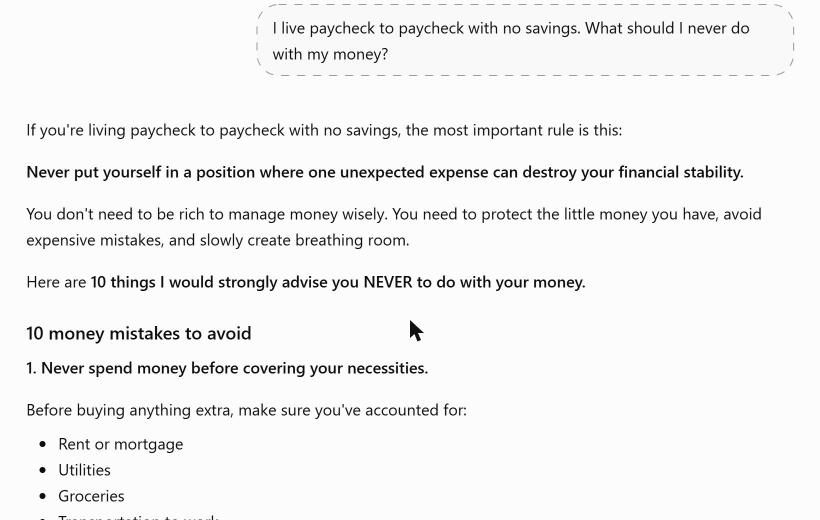
Investing and diversification were gone. In their place, it warned about the things that actually drain people when money is tight.
Its new top rules included:
- Cover necessities first: Rent, utilities, groceries, getting to work and minimum debt payments come before anything else.
- Avoid payday loans: It called them a “major financial trap.”
- Don’t buy on monthly payments: A $40 payment looks small until you add up all of them, including subscriptions you forgot you had.
- Don’t co-sign: “Not even family.”
- Call before you pay late: Ask about extensions, hardship programs and fee waivers before the due date.
- Save something, even $5: Your first goal is $100, then $250, then $500.
The payday loan warning is backed by real numbers. The CFPB says a fee of $15 for every $100 you borrow is common, which works out to almost 400% a year on a two-week loan. If you’re short before payday, I’d look at payday cash advance apps before you ever take one out.
Overdraft fees are part of the same problem. In 2025, 12% of adults with a bank account paid one, according to the Federal Reserve. The CFPB puts the typical overdraft fee at about $35.
Then ChatGPT said this:

“Being broke doesn’t mean you’re bad with money. Sometimes the problem isn’t spending habits. Sometimes it’s that housing, groceries, transportation, and other necessities consume nearly everything you earn.”
The Federal Reserve’s numbers back that up. In 2025, 16% of adults didn’t pay all their bills the month before. And 4 in 10 adults earning under $50,000 said they couldn’t cover even a $100 emergency.
That’s the biggest difference between the two answers. The first list was about habits, and it assumed you have money left over to manage. Once ChatGPT knew money was tight, it gave advice about the situation instead of a lecture.
What ChatGPT Left Out
ChatGPT’s first list skipped a few mistakes that can cost you thousands.
Here are the ones I’d add:
- Cashing out a retirement account early: Pull money from a 401(k) or IRA before age 59½, and the IRS usually charges a 10% additional tax on early distributions, on top of regular income tax.
- Skipping your employer’s 401(k) match: If your job matches what you put in and you don’t put in enough to get it, you’re leaving part of your pay on the table.
- Going without insurance: The broke version only listed insurance as a bill to pay first. One big uninsured bill, like a car crash or a hospital stay, can wipe out an emergency fund you spent years building.
In the first chat, ChatGPT also never asked about my situation. Its answer assumed I had money to save, invest and protect.
How I Researched ChatGPT’s Money Advice
I asked ChatGPT on November 17, 2026, using a free account with no chat history, a temporary chat and memory turned off. I asked five questions in total: the main question, a ranking by cost, which mistake people miss, what experts would disagree with, and the paycheck-to-paycheck version in a separate chat. Every screenshot in this post is from that session, and I didn’t regenerate any answer.
For the fact-check, I went straight to official sources: the Federal Reserve’s household survey and credit card rate data, the New York Fed, the St. Louis Fed, the FTC, the CFPB, the IRS and the SEC’s Investor.gov. For credit scores, I used the myFICO Loan Savings Calculator. When ChatGPT gave a stat, I opened its source link and compared the exact number and date.
Should You Trust ChatGPT With Money Advice?
For the basics, yes. Most of ChatGPT’s 12 rules are right, and three of the four stats it quoted were spot on.
But its first answer was written for someone with money to spare. It took three follow-up questions before it said its #1 rule needs an exception for people in poverty. So if you ask ChatGPT what you should never do with your money, tell it your real situation first, and check any number it gives you against the source.
So here’s where I’d start.
If you’re living paycheck to paycheck, start with ChatGPT’s smallest step: save $5 or $10 from each paycheck until you hit your first $100. To make it stick, I’d set up an automatic transfer into a separate savings account so you never see the money in checking.
If you want to see exactly where each paycheck goes, a budgeting app that’s actually free makes that easy.
And if the real problem is that your income is too small, not your spending, here are some legit ways to make extra money online.


