
You can get paid to deliver groceries through apps like Instacart, Walmart Spark, Shipt, and DoorDash.
You may see grocery delivery drivers on social media saying they make $30, $40, or even more per hour, but those numbers often don’t include expenses like gas, vehicle maintenance, and taxes.
Grocery delivery can be a great way to earn extra income (you may even be able to deliver groceries without a car!), but the exact amount you make depends on your location, available orders, tips, and even time!
If grocery delivery isn’t the right fit, you can also get paid to deliver packages, furniture, and bigger stuff through other delivery jobs.
In this guide, I’ll compare the top grocery delivery apps so you can see how they work, how fast you can get paid, requirements, and the highest paying grocery delivery gig for your unique situation.
Plus a few insider hacks to help you earn more (including tips!)
Best Apps That Pay You to Deliver Groceries
Here’s a quick side-by-side comparison table of the biggest apps that pay you to deliver groceries:
| App | Pay | Vehicle Needed | Instant Pay | Standout Feature |
|---|---|---|---|---|
| Instacart | Per batch + 100% of tips | Not always (Shop Only doesn’t require driving) | Yes | Shop without delivering |
| Walmart Spark | Per trip + 100% of confirmed tips | Car | Yes (OnePay) | Available in all 50 states |
| Shipt | $16/hour minimum offer rate + 100% of tips | Car | Yes | Only app with a published minimum offer rate |
| Amazon Flex | $18–$25/hour (Amazon estimate) | 4-door midsize sedan or larger | No | Choose your own payday |
| DoorDash | Per order + 100% of tips | Car (bike in some markets) | Yes | Restaurant and grocery deliveries in one app |
| Grubhub | Per order + 100% of tips | Car (bike in some markets) | Yes | Cash out about 15 minutes after delivery |
| Favor | $2–$14+ base pay + 100% of tips | Car, truck, motorcycle, or scooter | Yes | Texas-only |
| Weee! Flex | $30–$37/hour (company estimate) | Minivan, van, or large SUV | Not published | Highest advertised hourly pay |
| Weee! Fleet | Starts at $16.40/hour | Employee position | N/A | W-2 job with benefits |
| Market Wagon | Not published (driver reports ~$18-22/hr) | Registered vehicle | Not published | Scheduled delivery routes |
Now let’s look at what each app offers, who it’s best for, and the details that can make a real difference to your earnings.
1. Instacart
Instacart is the biggest grocery delivery platform in the country, with around 600,000 shoppers by its own count.
I cover the app in more detail in my Instacart review.
Key takeaways:
- Pay: Per batch, plus 100% of tips
- How you get paid: Direct deposit or the Shopper Rewards Card
- Payment schedule: Weekly, Wednesday to Friday
- Fastest payout: Instant Cashout, usually minutes after delivery
- Order types: Full Service, Shop Only, Delivery Only
- Requirements: Instacart does not publish a full list of requirements
Unlike some grocery delivery apps, Instacart offers several ways to earn.
You can complete Full Service orders, where you shop and deliver groceries, Shop Only orders, where you shop without delivering, or Delivery Only orders, where you pick up a completed order and deliver it.
I really like their Shop Only feature.
You see, with most grocery delivery apps you have to have a car to make money.
But with their Shop Only orders you can get paid for buying the groceries without having to deliver it to a shoppers place. You just hand it off at the store. It’s one of the easier personal shopper jobs to get into, since you skip the driving part entirely.
How much does Instacart pay?
Instacart shoppers are paid per batch, and you keep 100% of your tips.
Your earnings depend on factors like the size of the order, how many items you need to shop for, driving distance, demand in your area, and customer tips.
Because Instacart shoppers are independent contractors, remember that your actual take-home pay per hour will be lower after expenses like gas, vehicle costs, and taxes.
How does Instacart pay?
Instacart sends payments through direct deposit, or you can use the Shopper Rewards Card to receive payments.
Instacart also offers Instant Cashout, which lets shoppers access their earnings shortly after completing a delivery.
What does Instacart Instant Cashout cost?
Instacart charges a $1.50 fee if you transfer your earnings immediately to a personal debit card or bank account.
If you want to avoid cashout fees altogether, you can sign up for the free Shopper Rewards Card powered by Branch.
When you enable auto-payout with the card, your earnings are automatically deposited after every batch at no extra cost, plus you can earn cash back at the pump when buying gas.
How Instacart decides which batches you see
Instacart doesn’t hand out batches randomly.
According to Instacart’s own batch access page, it mostly comes down to how close you are to the store.
Once you’re close enough, a highlighted area shows up around that store in the app. Getting any closer after that doesn’t help. Everyone inside the highlighted area already has the best shot at that store’s batches.
Inside that zone, priority still depends on your Cart Star status, which is Instacart’s shopper rewards program.
Diamond Cart shoppers see batches first, then Platinum Cart, then Gold Cart, then everyone else.
To even qualify for a Cart Star tier, you need to keep your shopping quality score up and a customer rating of at least 4.7.
Instacart gives you the highest priority level for your first 10 batches, so you’re not stuck behind everyone else while you’re still learning the app. If you’re outside the highlighted area and tied with another shopper on distance and rating, Instacart says shopping efficiency breaks the tie. So the fastest way to see more batches is to get inside that zone and build up your Cart Star status.
2. Walmart Spark
Walmart Spark is Walmart’s delivery platform for independent drivers that operates nationwide across all 50 states.
I’ve looked at whether Walmart Spark is worth it in its own post, but the short version is that its biggest edge is coverage.
Key takeawasy:
- Pay: Per trip, plus 100% of confirmed tips
- How you get paid: Online banking or direct deposit through a third-party provider
- Fastest payout: Same-day earnings through OnePay after approval
- Offer types: Delivery, Shopping, Returns
- Where it works: All 50 states
Walmart Spark is available in all 50 states. Availability matters with grocery delivery apps. The highest-paying app in the world won’t help you if there are no openings in your area.
How does Walmart Spark work?
Unlike many grocery delivery apps, Spark gives you several ways to earn:
- Delivery: Pick up a prepared Walmart order and deliver it to the customer.
- Shopping: Shop for the customer’s order yourself, then deliver it.
- Returns: Pick up items from customers and bring them back to Walmart.
Returns can be worth watching because they skip some of the steps that slow down grocery orders. You don’t need to shop, wait in checkout lines, or deal with missing items and substitutions.
How Spark actually sends you offers
There are a few different ways Spark sends orders to drivers:
- Round Robin (Just for You)
- First come, first serve (FCFS)
- ASAP or surge offers
Knowing how each one works can help you decide when to accept an order and when to wait.
Round Robin (Just for You) offers
These offers are sent to one driver at a time.
If you don’t accept it, Spark moves the offer to another driver.
These offers have a countdown timer, and they affect your acceptance rate in the app’s My Metrics section. Declining the offer or letting the timer expire both count the same.
First come, first serve (FCFS) offers
FCFS offers work differently.
Spark shows these offers to every driver in your zone at the same time. They usually appear closer to the pickup window than Round Robin offers.
There is no countdown timer, and according to driver reports, these offers don’t affect your acceptance rate.
ASAP or surge offers
Then there are what many drivers call ASAP or surge offers.
According to drivers on r/Sparkdriver, these are often orders that didn’t get picked up after being sent as Round Robin or FCFS offers. Instead of sitting there forever, Walmart increases the pay and sends the offer back out to drivers.
Drivers report that the increase is usually around $1 each time, up to about $8 more total. Like FCFS offers, ASAP offers reportedly don’t count against your acceptance rate.
This is why many experienced Spark drivers don’t stress too much about having a lower acceptance rate. A bad Round Robin offer you skip might come back a few minutes later with higher pay, and your stats may not take a hit.
Good to know
By the way, your location can also affect which offers you see. Walmart says you won’t receive offers while you’re within 150 feet of a store because that area is reserved for drivers already picking up orders. If you’re between 150 feet and one mile away, drivers have the same priority, but a higher customer rating can improve your chances of getting an offer.
How much does Walmart Spark pay?
Walmart Spark drivers are paid per trip, and drivers keep 100% of confirmed customer tips.
Your earnings depend on the type of offer you accept, how far you drive, the time required, your location, and customer tips.
Since Spark drivers are independent contractors, remember that your actual take-home pay will be lower after expenses like gas, vehicle maintenance, and taxes.
How does Walmart Spark pay?
Spark drivers can receive payments through online banking or direct deposit using a third-party payment provider.
After approval, drivers can also use OnePay for same-day earnings.
Spark Driver Rewards
Spark also runs a rewards program called Spark Driver Rewards that hands out perks based on how much you drive.
There are two tiers, and every driver in good standing starts at Tier 1.
Tier 1 gets you OnePay for same-day earnings and cash back at Walmart, plus up to 65% off Keeper for tracking your write-offs at tax time.
As a Tier 2 driver you get other benefits such as:
- Discounted phone plans through T-Mobile, or $35 unlimited through Verizon
- Six months of Driver Premium dashcam and roadside assistance for $19.99
- A one-month Walmart+ membership, which includes fuel discounts
The fuel savings may be the most useful perk because gas is one of the biggest expenses for delivery drivers.
Shipt
Shipt is a grocery delivery app where you shop for customers’ orders and deliver them to their door. I put together a full Shipt review if you want a closer look at the shopper side.
Key takeawasy:
- Pay: $16 an hour minimum offer rate, plus 100% of tips
- How you get paid: Direct deposit
- Payment schedule: Weekly, every Friday
- Fastest payout: Instant Payout for $0.49, usually within about an hour
- Where it works: Everywhere except Alaska, Wyoming, and West Virginia
A lot of people assume grocery delivery means owning a car. But you can deliver for Shipt using a vehicle you don’t own as long as you’re listed as an insured driver on the policy.
How much does Shipt pay?
Unlike most grocery delivery apps, Shipt is the only one in this guide that promises a minimum offer rate.
Shipt says shopper offers are calculated using a minimum of $16 per hour, plus 100% of your tips.
Obviously, your actual earnings can still vary depending on your market, how many orders are available, how long each order takes, and the tips you receive.
Keep in mind that this is before expenses like gas, car maintenance, and taxes.
How does Shipt pay?
Shipt sends weekly payments through direct deposit every Friday.
If you need your money sooner, you can use Instant Payout to cash out through Stripe for a $0.49 fee (you get paid within an hour or so).
But before you rely on Instant Payout, know these limits:
- Maximum of three cash outs per day (7 PM to 7 PM Central cycle)
- $500 daily payout limit
- You need a debit card on file and at least one successful weekly direct deposit
- Tips of $50 or more cannot be cashed out instantly
I know that last one sucks but those are the rules, lol.
What happens if a Shipt order gets canceled?
If a customer cancels an order before you start shopping, you won’t receive payment.
However, if the cancellation happens after you begin shopping, Shipt pays a percentage of the original offer.
That means once you scan your first item, at least some of your time is protected.
Shipt’s Preferred Shopper program can bring you repeat customers
Shipt has a feature that lets good shoppers build something close to a regular client base.
If a customer rates you 5 stars, they get the option to add you as a Preferred Shopper.
According to Shipt’s own help center, accepting that request increases the odds that customer’s future orders come back to you specifically.
It’s a nice reminder that the quality of your service does more than earn a good rating in the moment. A customer who’s happy enough to add you as a preferred shopper can turn into repeat business, which is a lot more predictable than waiting on random batches.
How Shipt referral bonus works
Shipt sometimes offers a referral bonus when you invite someone to become a shopper, but the amount can vary by market and promotion.
Before you count on the bonus, make sure your referral completes all the requirements.
The person you refer must:
- Complete 30 orders within 40 days of approval.
- Complete all orders on time.
- Avoid Target Delivery Only routes, which do not count toward the referral requirement.
The bonus is only paid after your referral meets all of Shipt’s requirements, so don’t assume simply sending someone your referral link will trigger the payment.
Amazon Flex
Amazon Flex works a little differently from most grocery delivery apps. Instead of accepting individual orders, Flex drivers choose delivery blocks and complete assigned routes.
Key takeawasy:
- Pay: Amazon says most drivers earn $18 to $25 an hour
- How you get paid: Direct deposit to your checking or savings account
- Payment schedule: You choose your payment day or days
- Fastest payout: Set your account to get paid every weekday
- What you need: Be at least 21 years old and have a 4-door midsize sedan or larger vehicle
Most people know Amazon Flex for delivering Amazon packages, but it can also include grocery deliveries from Whole Foods Market.
How much does Amazon Flex pay?
Amazon says most Flex drivers earn between $18 and $25 an hour.
That is one of the few cases where a major delivery platform publishes its own hourly earnings estimate. However, it is not a guaranteed wage.
Your actual earnings depend on factors like your location, the type of delivery block you accept, how long the route takes, tips, and other expenses such as gas and vehicle maintenance.
How does Amazon Flex pay?
Amazon Flex pays drivers through direct deposit to their checking or savings account.
You can choose your preferred payment day or days.
Amazon also lets you set your account to receive payments every weekday if you want faster access to your earnings.
Does Amazon Flex deliver groceries?
This is where many people get confused.
When you visit the Amazon Flex website, most of the information focuses on delivering Amazon packages.
However, Amazon’s Flex FAQ says delivery blocks can include different types of deliveries, including Amazon.com or Whole Foods Market.
That means grocery deliveries are available through Amazon Flex, but they usually come through Whole Foods Market rather than a separate Amazon grocery driver app.
How Amazon Flex offers and blocks work
Amazon Flex offers usually come in three different ways:
- First-come, first-served blocks
- Reserved Offers
- Instant Offers
1. First-come, first-served blocks
Most Flex blocks are first come, first served. That means drivers are competing for the same available blocks, so it helps to check the Offers screen regularly once you know when you want to work.
2. Reserved Offers
Amazon lists these at the top of your Offers screen and holds them just for you for a set amount of time. If you want more consistent scheduling, these can be easier to grab than waiting for public offers.
3. Instant Offers
According to Amazon’s own guide for delivery partners, Instant Offers are usually Whole Foods and Amazon Fresh grocery deliveries that start immediately after you accept them. They also allow you to earn tips on top of your base pay.
To receive Instant Offers, turn on the “Available Now” toggle while you’re within 15 minutes of a participating pickup location.
If an offer becomes available nearby, Amazon sends you a notification. But you only have about 60 seconds to accept it.
Amazon also confirms block prices can rise when demand is high, on both scheduled blocks and Instant Offers. So if you keep checking back during a busy stretch instead of locking in a block days ahead, you can sometimes catch a higher-paying offer than what was available earlier.
Amazon is shifting more grocery orders online
Amazon has been moving more of its grocery business toward online ordering and delivery.
In January 2026, Amazon announced it was closing Amazon Go and Amazon Fresh physical stores and converting some locations into Whole Foods Market stores.
At the same time, Amazon said it was expanding online grocery delivery, including same-day delivery for fresh and perishable items. Amazon also reported that its perishable grocery sales through same-day delivery had grown significantly.
If you drive for Amazon Flex, that shift could mean more grocery delivery opportunities as Amazon moves more orders online instead of relying on customers visiting physical stores.
The Amazon Flex card can help reduce expenses
Like most gig delivery jobs, Amazon Flex drivers are independent contractors and are responsible for their own expenses, including gas, mileage, parking, and tolls.
The Amazon Flex Debit Card can help offset some costs by offering:
- Up to 6% cash back on fuel and eligible EV charging
- 2% back on Amazon.com purchases
- 1% back on other purchases
Amazon also offers a delivery option called Amazon Now, which uses Flex drivers for shorter delivery blocks that typically last under an hour. This can be useful if you only have a small amount of time available to work.
Food Delivery Apps That Also Pay You to Deliver Groceries
If you’re already delivering food, you may not need to sign up for another app to start making money from grocery deliveries.
Both DoorDash and Grubhub let drivers shop for and deliver groceries. In fact, both companies say grocery orders pay more per delivery, on average, than regular restaurant orders.
DoorDash
DoorDash calls its grocery delivery program Shop & Deliver.
Instead of picking up a restaurant order, you’ll shop for the customer’s groceries yourself, pay with a DoorDash-funded Red Card, and then deliver the order.
Key takeawasy:
- Pay: Per order, plus 100% of tips
- How you get paid: Direct deposit, or a DoorDash Crimson account
- Payment schedule: Weekly, in your account by Wednesday night
- Fastest payout: Fast Pay for $1.99
- What you need: A Red Card, digital or physical
How much does DoorDash pay?
DoorDash pays per delivery, not by the hour.
And they don’t guarantee a specific hourly rate because earnings vary by location, demand, and the orders you accept.
Your earnings include base pay, 100% of customer tips, and promotions such as Peak Pay when available.
Doordash has one of the best tips for DoorDash drivers. According to the company, Dashers earn more on a Shop & Deliver order than on a restaurant order, based on average Dasher payouts nationwide. It does make sense though when you think about it, a shop order takes more of your time and usually covers more distance.
How does DoorDash pay?
DoorDash sends weekly payments by direct deposit, with most deposits arriving by Wednesday night.
If you want your money sooner, you can use Fast Pay for a $1.99 fee.
You can also get paid through a DoorDash Crimson account, which gives you access to Instant Pay.
By the way, if you are wondering what happened to their old payment program, DasherDirect, DoorDash discontinued it on April 1, 2025. They replaced it with Crimson, which is basically a personal banking account that gives you instant access to your earnings through Instant Pay. It also offers cash-back rewards, with no credit check or application fee.
DoorDash’s Pro Shopper program
Once you’ve completed 20 Shop & Deliver orders, DoorDash automatically considers you for something called Pro Shopper status.
According to DoorDash’s own help center, Pro Shoppers get priority access to some of the highest-paying shopping offers in their area, and you’ll see a Pro Shopper icon on offers you were bumped up for.
Your status isn’t based on how fast you move through the store. It’s based on your Shopping Ratings over your last 40 Shop & Deliver orders. DoorDash looks at how often you find the exact item ordered, how often you need a substitution, and whether customers report wrong or missing items.
So the fastest way to reach Pro Shopper status isn’t rushing. It’s getting the order right the first time. That lines up with DoorDash’s own coaching to Dashers about checking expiration dates and sending photos of substitutions instead of guessing.
Sometimes the checkout terminal treats your Red Card like a debit card and asks for a PIN. If that happens, enter 0000. Knowing that ahead of time can save you from standing at the register waiting for support while frozen food melts in your cart.
Grubhub
Grubhub’s grocery delivery program is called Shop and Pay.
Instead of only picking up prepared restaurant orders, you’ll shop for the customer’s groceries, pay using your Grubhub Driver Card, and deliver the order.
Key takeawasy:
- Pay: Per order, plus 100% of tips
- How you get paid: Direct deposit
- Fastest payout: Instant Cash Out, 15 minutes after a delivery
- What you need: An activated Grubhub Driver Card
After completing 20 deliveries, Grubhub assigns you a driver level based on your performance, and that level decides a lot about your schedule.
How Grubhub’s driver levels actually work
Grubhub has three driver levels:
- Partner
- Pro
- Premier
Once you hit 20 deliveries, you’re placed at Partner status by default.
To move up, Grubhub’s own recognition program page says your level gets checked every Monday based on three stats from your last 14 days: your offer commitment rate, your on-time arrival rate at the merchant, and your schedule commitment rate.
Hit better than 80% on all three and you reach Pro.
Hit better than 95% on all three and you reach Premier, which also unlocks automated scheduling and priority for catering orders.
The real benefit of moving up is getting first pick of next week’s blocks.
Premier drivers get first access, Pro drivers get access a day after that, and Partner drivers get whatever’s left.
How much does Grubhub pay?
Grubhub pays drivers per order, and you keep 100% of your tips.
Grubhub says Shop and Pay grocery orders pay more per delivery, on average, than restaurant deliveries because they usually require more time. You’re not just picking up an order; you’re shopping for items, handling substitutions, checking out, and completing the delivery.
How does Grubhub pay?
Grubhub pays drivers through direct deposit.
If you want access to your earnings faster, you can use Instant Cash Out, which lets you transfer available earnings about 15 minutes after completing a delivery.
How Grubhub handles substitutions
One thing I really like about Grubhub is the way it handles Substitutions.
They ask the customer up front what they want done when an item is out of stock, and giving them three choices:
- replace it,
- contact me,
- or refund it.
That way you (the driver) don’t have to waste time trying to figure it out on your own.
While shopping, you’ll scan each item’s barcode so the app can verify that you picked the correct product. If a barcode doesn’t scan correctly, you can use the “Add item anyway” option instead of getting stuck.
Make sure your Grubhub Driver Card is activated before accepting grocery orders. Without an activated card, you can still deliver restaurant orders, but Shop and Pay grocery offers will not appear in your app.
Regional and Niche Grocery Delivery Apps
These apps don’t operate everywhere like the national platforms, but they can be worth checking if the bigger apps aren’t available in your area.
A few also stand out because they offer something different, like guaranteed tips, employee benefits, or scheduled routes.
Favor
Favor is a grocery and delivery app owned by H-E-B. It only operates in Texas, where it serves more than 400 cities.
Favor calls its drivers Runners.
Key takeawasy:
- Pay: $2 to $14+ base pay per order, plus 100% of tips
- How you get paid: Automatic weekly deposit
- Fastest payout: Instant Pay to a debit card for $0.99
- Where it works: Texas only, 400+ cities
- What you need: 18 or older, plus a car, truck, motorcycle, or scooter
Favor Runners complete different types of deliveries, including grocery orders from H-E-B.
Because Favor and H-E-B are part of the same company, the app is designed around H-E-B stores.
It can show item locations, store maps, and customer substitution preferences while you shop.
How much does Favor pay?
Favor pays Runners per order. Base pay can range from $2 to $14+, and Runners keep 100% of their tips.
One thing that makes Favor different is that orders placed through Favor’s own app include a required minimum tip. However, third-party orders may follow different rules.
Favor provides a free Runner card that you use during checkout. At H-E-B, you can pay using a QR code or tap-to-pay option. You don’t need previous delivery experience, and Favor provides “Running 101” training videos to help new Runners get started.
Weee! Flex
Weee! Flex is a grocery delivery option from Weee!, a company that specializes in Asian and Hispanic grocery delivery.
Key takeawasy:
- Pay: Weee! says most Flex drivers earn $30 to $37 an hour
- How you get paid: Not published by Weee!
- Payment schedule: Not published by Weee!
- What you need: 21 or older, a minivan, van, or large SUV, plus 6 months of delivery experience
Weee! Flex groups deliveries along a route instead of sending you one customer at a time.
You pick the routes that fit your schedule and finish them inside the assigned window, and there’s no minimum number of hours you have to commit to.
How much does Weee! Flex pay?
According to Weee!, most Flex drivers earn $30 to $37 an hour.
Your actual earnings may vary depending on your location, route availability, delivery time, and other factors.
Before you compare this number with other grocery delivery apps, remember that Flex drivers need a larger vehicle ( a minivan, a delivery van or a large SUV, and a sedan doesn’t qualify.) and previous delivery experience, which can add extra costs and requirements.
How does Weee! Flex work?
Weee! Flex works differently from apps where you accept one order at a time.
Instead, drivers deliver grouped routes. You choose available routes that fit your schedule and complete the deliveries within the assigned time window.
There is no minimum number of hours you have to commit to, which gives you some flexibility compared with a traditional delivery job.
One thing to confirm before signing up is how payments work. Weee! does not publish payout timing or payment methods for Flex drivers on its driver page, so ask about payment details before investing in a larger vehicle for the job.
Weee! Fleet
Weee! Fleet is different from most grocery delivery apps in this guide because it is a regular employee job, not gig work.
Key takeawasy:
- Pay: Starts at $16.40 an hour.
- How you get paid: As a W-2 employee, not a contractor
- Payment schedule: Not published by Weee!
- Hours: Around 40 a week, first and second shifts
Instead of choosing individual delivery orders whenever you want, you work as a W-2 employee.
The job also comes with healthcare, retirement, other benefits and bonus opportunities.
You work around 40 hours a week on first or second shift, and that can include weekends.
How much does Weee! Fleet pay?
Starting pay is $16.40 an hour, and Weee! says drivers make $25 to $30 an hour once tips are counted.
Because this is a W-2 job, eligible employees can also receive overtime pay at time and a half after working more than 40 hours in a week.
The trade-off: less freedom, more stability
The biggest difference comes down to flexibility.
With gig apps, you can usually decide when you want to work. With Weee! Fleet, you get a set schedule and consistent routes instead.
If you’ve been doing gig work and you’re tired of not knowing how much you’ll earn from week to week, a scheduled employee delivery job may be worth considering.
Market Wagon
Market Wagon delivers from local farms and food makers.
It operates through 20 fulfillment centers across the Midwest and Southeast (including Indianapolis, Chicago, Pittsburgh, Baltimore, Knoxville, and St. Louis). They don’t operate on the West Coast, and coverage is limited in the Northeast.
Key takeawasy:
- Pay: Not published; driver reports average $18 to $22 an hour
- How you get paid: Not published; driver reports are mixed on timing
- Delivery days: Tuesdays or Thursdays, depending on your center
- Where it works: 20 fulfillment centers across the Midwest and Southeast
- What you need: 18 or older, a registered vehicle, and the ability to carry 40 lbs up a flight of stairs
Its routes are called gigs, and they only run on Tuesdays or Thursdays depending on which fulfillment center covers your area.
How grocery delivery with Market Wagon works
Market Wagon isn’t a shop-and-deliver job like Instacart or Shipt.
You start by applying to become a driver.
Once you apply and get approved, the company sends you a text when delivery work is available near you.
If you accept the route, the delivery instructions are sent directly to your phone.
Orders come from local farms and small food makers, and they’re already packed into insulated totes with cold packs before you ever touch them.
Your job is to grab those totes, follow your assigned route, and hand off each order.
When you drop off a new delivery, you also pick up the empty tote and cold packs from the customer’s last order, so Market Wagon can reuse them instead of throwing them out.
That means there’s no shopping, no scanning, and no payment card involved.
If you want grocery gig work without the in-store part, this is about as far from Instacart as it gets.
This isn’t an app you open when you feel like making money. It’s closer to being on call one or two days a week.
How much does Market Wagon pay?
Market Wagon doesn’t publish driver pay rates or a payout schedule on its driver page, so there’s no official number to point to.
Indeed’s own salary data for Market Wagon delivery drivers puts the average at $20.62 an hour nationally, though that drops to about $15.69 an hour in Indianapolis specifically.
SimplyHired shows a similar $20.42 an hour average, but that’s based on only 6 reported salaries, so treat it as a rough estimate rather than a hard number.
Driver reports are mixed on how fast you actually get paid too. Some say deposits land the same day, others describe a weekly cycle. Since Market Wagon doesn’t publish either figure, ask about both pay and payout timing for your specific route before accepting your first gig.
Best Grocery Delivery App for Your Situation
The best delivery apps to work for isn’t the same for everyone.
For example, if you want to make more money overall, an app that pays less per delivery but gives you more orders throughout the week may be better than an app that pays more per order but has far fewer opportunities.
Here’s what I would suggest based on your situation:
- Best for nationwide availability: Walmart Spark (available in all 50 states)
- Best for guaranteed minimum pay: Shipt
- Best for flexible delivery blocks: Amazon Flex
- Best if you don’t have a car: Instacart Shop Only
- Best for fastest cash access: Grubhub (about 15 minutes
- Best W-2 grocery delivery job: Weee! Fleet
- Best for van-based routes: Weee! Flex
- Best Texas option: Favor
Also, you don’t have to just rely on one app.
I know a lot of side hustlers use few grocery delivery apps at the same time because when one app is slow or has no available gigs, another one may have orders ready. So they end up making more money this way.
How to Start Delivering Groceries
Getting started is usually pretty simple.
You apply online, pass a background check, get approved, and then start accepting grocery orders through the app.
And no, with most grocery delivery apps you don’t’ have to do an interview or send in a resume.
Here’s how I’d start delivering groceries as a beginner:
- Check your ZIP code: Availability can vary by neighborhood, not just city.
- Apply to multiple apps: Two or three applications give you more options if one has a waitlist.
- Pass the checks: Complete the background check and driving record check if required.
- Get approved: Wait for any required shopper card or account setup steps.
- Take your first order: Start during a busy grocery period when more orders are available.
By the way, for apps that require a shopper card, you usually can’t accept shopping orders until the card arrives in the mail.
Shipt, DoorDash, Grubhub, and Favor all use cards that let you pay for customer orders at checkout.
What I like about DoorDash is that you don’t have to wait for the physical card. As an approved Dashers, you can add a digital Red Card to your phone wallet and start accepting eligible Shop & Deliver orders immediately.
Requirements to Deliver Groceries
The good news is that most grocery delivery apps don’t require special experience or a resume.
The main things they care about are your age, vehicle, license, insurance, smartphone, and whether you can pass a background check.
Most apps have similar requirements, but there are some differences.
Here’s a table that shows grocery delivery driver requirements:
| Requirement | Most Apps | Exceptions |
|---|---|---|
| Minimum age | 18+ | Amazon Flex: 21+ Weee! Flex: 21+ DoorDash: 19 in 13 states; 21 for new CA applicants |
| Vehicle | Reliable vehicle | Instacart Shop Only: no driving Weee! Flex: minivan, van, or large SUV Amazon Flex: 4-door midsize sedan+ Shipt: 1997+ vehicle |
| Delivering without a car | Not offered on most grocery apps | Instacart Shop Only: shop in-store only DoorDash/Grubhub: bike, e-bike, or scooter in some markets |
| Driver’s license | Valid license | Walmart Spark requires a REAL ID-compliant license. |
| Auto insurance | Personal auto policy | DoorDash: own coverage required for its coverage to apply |
| Smartphone | iPhone or Android | Shipt requires iOS 13+ or Android 7+ |
| Background check | Required | Weee! Flex: motor vehicle record check too |
| Lifting | Carry groceries | Shipt/Weee! Flex: up to 50 lbs Market Wagon: 40 lb packages upstairs |
| Experience | Usually none | Weee! Flex: 6 months delivery experience |
| Payment card | Needed for shopping orders | Cards provided by the companies |
What Happens If a Grocery Delivery App Has a Waitlist?
Getting put on a waitlist doesn’t mean the app rejected you.
It usually just means there are already enough drivers or shoppers in your area, so the company isn’t accepting more people right now.
Three apps in this guide use waitlists, although they call them different things:
- Shipt: Closes signups when your area already has enough shoppers.
- Grubhub: Adds you to a waitlist when your market is full.
- Amazon Flex: Uses an “interest list” when there are no delivery openings nearby.
Instacart runs its own version too, and getting off the Instacart waitlist mostly comes down to your zip code.
If an app puts you on a waitlist, join it anyway. It costs you nothing, and you may get approved once demand goes up in your area.
What to do while you wait
First, check nearby ZIP codes.
Most delivery apps assign drivers by smaller zones, not entire cities.
A ZIP code just a few minutes away may have openings even if your area is full.
You can also apply to other apps at the same time. For example, Walmart Spark is available in all 50 states, so it may be worth checking if another app has too many drivers in your area.
How Grocery Delivery Apps Actually Pay You
Most grocery delivery apps don’t pay you by the hour. They pay a set amount for each order, and that offer is usually based on how much time and effort the app expects the job to take.
Your real hourly rate is super easy to figure out. Just take the amount you got paid and divide it by how long the whole thing actually took.
This is why two drivers doing similar deliveries can earn different hourly rates (maybe one waited longer, drove farther, or had more downtime.).
Why finishing faster matters
The amount an app offers you usually does not change if you finish faster or slower.
A $20 order still pays $20 whether it takes you 50 minutes or two hours.
- Finish in 50 minutes: about $24/hour
- Take 2 hours: $10/hour
This is why experienced drivers focus on efficiency, not just the dollar amount shown on the screen.
A $25 order with 10 items at a store you know well may be better than a $35 order with 60 items at a store where you waste time searching.
Shipt shows the math behind your pay
Shipt’s Earnings Standard is one of the few places where a grocery delivery app explains its pay formula:
Offer Amount × 60 ÷ Estimated Time = Pay Per Hour
For example, a $20 order with a 75-minute estimate works out to $16 an hour, which Shipt says is its minimum offer rate.
In some markets, Shipt says the rate can be above $27 an hour.
What grocery apps look at before sending an offer
Each app uses its own formula to calculate offers.
Some of the factors include:
- Instacart: Distance, item count, item weight, estimated shopping time
- Walmart Spark: Distance, item count, apartment deliveries, heavy items
- DoorDash: Estimated time, distance, order demand
- Grubhub: Mileage, delivery type, delivery time
- Amazon Flex: Delivery block with earnings range or, in some markets, “$XX + tips”
As you can see, they don’t always factor in the extra time you spend searching for a hard-to-find item, waiting at checkout, fixing a substitution, or dealing with a customer issue.
Now, remember that the pay you see isn’t always the final amount!
Instacart, for example, can add extra pay in certain situations when an order requires more work or when there aren’t enough shoppers available.
These include:
- Heavy pay: At least $2 when qualifying heavy items total 50 pounds or more
- Boosts: Extra pay when there aren’t enough shoppers available
How Much Can You Really Make Delivering Groceries?
Now that you know how grocery delivery apps calculate their offers, the next question is the one all gig workers care about: how much money do you actually keep?
The amount you see in the app is your gross pay, not your net pay (the exact amount you actually keep after expense, taxes, etc.).
Grocery delivery depends heavily on your vehicle. Every mile you drive adds wear and tear through fuel, maintenance, repairs, insurance, and depreciation.
A realistic example
Let’s look at a five-hour Shipt shift using made-up numbers.
This is only to show the math, not a typical earnings guarantee.
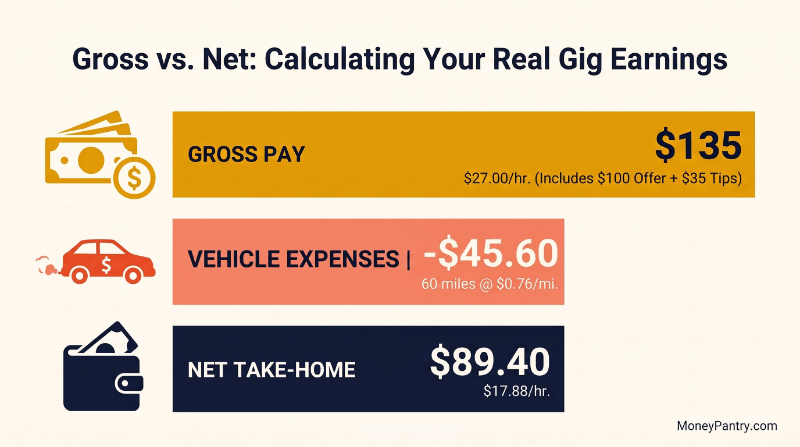
- 5 orders at $20 offer pay: $100
- Tips: $35
- Gross pay: $135 ($27/hour)
- 60 miles driven at the 2026 IRS mileage rate: -$45.60
- Estimated take-home: $89.40 (about $17.88/hour)
On paper, this shift looks like $27 an hour.
But when you factor in the cost of using your car, it’s closer to $18 an hour, and you still need to plan for taxes.
What the IRS mileage rate actually means
A lot of side hustlers misunderstand the IRS mileage rate, so let me explain it.
You see, that (as of July 1, 2026) 76 cent IRS mileage rate is not money you literally pay every time you drive a mile.
It’s just the IRS’s way of guessing how much it really costs to use your car for work.
For 2026, the business mileage rate is 76 cents per mile. It covers stuff like gas, oil changes, tires, repairs, insurance, and even how your car loses value over time.
By the way, the rate changed during the year. It was 72.5 cents per mile from January through June 2026, then increased to 76 cents starting July 1, 2026 (I am assuming most of it because of the gas price hikes).
So for example, if your car gets 25 miles per gallon and you drive 60 miles, you’re only burning about 2.4 gallons of gas.
The rest of that “cost” shows up later when you need new tires, repairs, or your car wears down. So your actual gas cost for those 60 miles is way less than $45.
Don’t forget about taxes
Vehicle costs are not the only thing that affects what you keep.
Grocery delivery apps don’t take taxes out of your payments, so you are responsible for setting aside money for income taxes and self-employment taxes.
Since driving is usually your biggest expense, start tracking your mileage from your first delivery with a good mileage tracker app.
For many gig workers, the mileage deduction is one of the biggest tax deductions available.
I’m not a tax professional, so this isn’t tax advice. But if grocery delivery becomes a regular source of income, it may be worth talking with a tax professional who understands gig work.
How Grocery Delivery Tips Work
After accounting for vehicle costs and taxes, tips are one of the biggest factors that can change your take-home pay.
You keep 100% of tips on every app in this post.
But one thing many new drivers don’t realize is that with some apps the tip isn’t always locked in the moment you drop off the order.
Of course, just like other gigs and jobs that pay tip, like pizza delivery, small things that improve the customer’s experience can make a difference.
For example, I use Walmart delivery as a customer pretty often. Sometimes I get wrong items, bad fruit and vegetables, etc.
I usually tip about $5 to $10 on a $30 to $50 order, but mistakes like these definitely affect how I feel about increasing that tip.
A friend of mine drives DoorDash, and he sees the same issue from the other side. Restaurants sometimes hand him the wrong food, and he doesn’t find out until the customer opens the bag.
Getting the order right is the whole job, and it’s one of the easiest ways for you to get more tips and make more money overall. So make sure to always check the order before leaving the store or restaurant.
Another “tip” (pun intended!) is to be nice. Seriously, most people tend to tip you more if you just smile and are pleasant over all.
DoorDash’s Shop & Deliver coaching program also has some good tips.
For example, they tell Dashers to introduce themselves in the app, check expiration and use-by dates, choose items with the furthest dates, and send customers photos of produce and meat.
I like that photo idea a lot since customers can’t watch you choose their groceries, a picture shows them you didn’t just grab the first package you saw.
How Instacart tips work
Instacart is a good example of why tips aren’t always final.
Instacart has this feature where customers can increase your tip for up to 14 days after delivery, but they can’t lower it more than 2 hours after delivery.
Instacart also has a tip protection policy that I really appreciate.
If a customer removes the tip without reporting an actual problem with the order, Instacart can cover up to $10. If a batch is split between two shoppers, the tip is split evenly between them.
Frequently Asked Questions
Yes. Walmart pays drivers through the Spark Driver app. You work as an independent contractor accepting delivery offers, and Spark operates in all 50 states.
Weee! Flex advertises the highest pay at $30 to $37 per hour, but it requires a van and delivery experience. Amazon Flex advertises $18 to $25 per hour, and Shipt publishes a minimum offer rate.
Yes. Making $100 a day is possible, but that is gross pay before vehicle costs and taxes. Your actual take-home amount will depend on your app, location, and expenses.
They can be worth it if you want flexible side income and have a reliable vehicle. Your real earnings depend on order volume, tips, mileage, and how efficiently you work.
Instacart, Walmart Spark, and DoorDash are popular beginner options because they are widely available and have simple signup processes. The best choice depends on what is available in your area.
Most grocery delivery apps require a car. Instacart Shop Only is one exception because you shop orders and hand them off at the store without driving. If you don’t have a car, there are other ways to make money without a car too.
Not automatically, but most apps let you cash out early for a fee. Grubhub is fastest at 15 minutes after a delivery, Shipt charges $0.49, Favor charges $0.99 and DoorDash charges $1.99.
No. Dumpling does not pay you to deliver groceries. It sells software that helps you run your own grocery shopping business.
How I researched this topic
I researched each grocery delivery app using official company websites, driver help centers, and earnings information available in July 2026. I verified pay rates, fees, payout schedules, requirements, and app policies directly from company sources. If an app did not publish a specific number, I said so instead of repeating estimates from other websites. The mileage calculations use the IRS 2026 business mileage rate from Internal Revenue Bulletin 2026-29, which increased the standard rate to 76 cents per mile starting July 1, 2026.
Start Getting Paid to Deliver Groceries
Getting paid to deliver groceries sounds simple: accept an order, shop or pick it up, and drop it off.
But the drivers who make the most from these apps usually do a little more than just complete deliveries.
The best app depends on your location, how quickly you can start, how much you can earn, and how much driving your vehicle can handle. That is why many drivers apply to multiple apps instead of relying on just one.
Once you start, focus on the things you can control. Learn your stores, choose orders that make sense for your time, check items carefully, and communicate well with customers.
Those small habits can help you turn grocery delivery from a few random orders into a more reliable way to earn extra money on your schedule.


