Too Good To Go promises to help you save up to 70% on food from restaurants, bakeries, cafes, and grocery stores that would otherwise go to waste.
But is Too Good To Go legit, and is it actually worth downloading?
In this Too Good To Go review, I’ll explain how the app works, how much you can really save, its biggest downsides, and whether it’s the right choice for you.
Is Too Good To Go Legit?
Yes. Too Good To Go is a legitimate app, not a scam.
It lets you buy leftover food from restaurants, bakeries, grocery stores, and other local businesses at a big discount instead of letting it go to waste.
The company launched in Denmark in 2015 and has grown into one of the world’s largest food waste apps.
It operates in more than 19 countries across Europe and North America, including 29+ U.S. cities, and says it has helped save hundreds of millions of meals from being thrown away.
Too Good To Go is also a certified B Corp, meaning it meets independent standards for social and environmental impact.
Now, Too Good To Go isn’t accredited by the Better Business Bureau (BBB) which is pretty common for international companies and isn’t, by itself, a sign that the app isn’t trustworthy.
So yes, Too Good To Go is legit.
The bigger question is whether you’ll actually save money using it.
Let’s find out…
Too Good To Go at a Glance
| Best For | Saving money on leftover food from restaurants, bakeries, and grocery stores |
|---|---|
| Biggest Savings | Up to 70% off the original price |
| Starting Price | About $3 per Surprise Bag |
| Service Fee | None for buyers |
| Available In | 19+ countries and 29+ U.S. cities |
| Overall Verdict | A legitimate app that can save you a lot of money if you don’t mind surprise food. |
How Much Can You Actually Save?
Too Good To Go sells discounted Surprise Bags filled with unsold food from restaurants, bakeries, cafes, and grocery stores. (I’ll explain exactly how they work in the next section.)
Surprise Bags usually start around $3, though the exact price depends on the business and location.
Most bags sell for about one-third of their original value, so saving 50% to 70% is common.
One thing I personally really like about Too Good To Go is that it doesn’t charge buyers a service fee. The price you see in the app is the price you pay, plus tax where it applies.
That’s different from some competing food rescue apps. FlashFood, for example, added a service fee of roughly 8 percent on top of the listed price in January 2026.
That said, not every Surprise Bag offers the same value, and how much you save depends mostly on where you buy it.
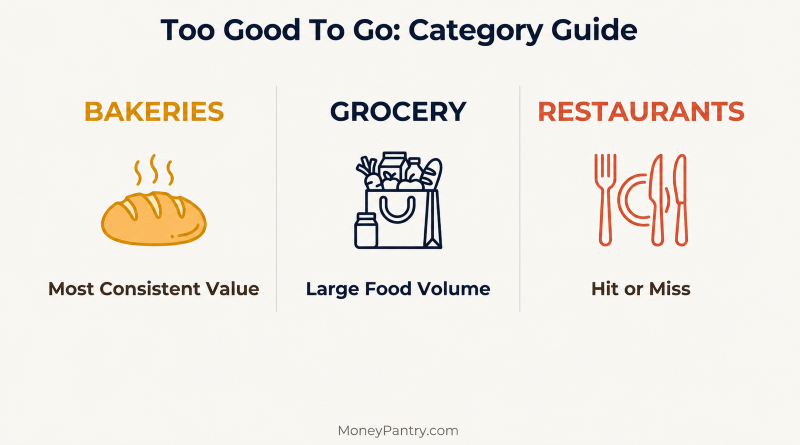
In general, bakery and grocery store bags are the safest bet, while restaurant bags can be more hit or miss.
| Bag Type | What You Might Get | What to Expect |
|---|---|---|
| Bakery | Bread, pastries, bagels, desserts | Usually the best value and the most consistent. |
| Grocery Store | Produce, dairy, pantry items, prepared foods | Often packed with a wide variety of food worth two to three times what you pay. |
| Restaurant | Prepared meals or leftover menu items | More unpredictable. Some bags are excellent deals, while others may contain only a small meal. |
National chains tend to be even more predictable.
Here are a few examples:
| Store | Bag Price | What’s Inside | Value |
|---|---|---|---|
| Whole Foods (Prepared Foods) | $9.99 | Soups, ready meals | $30 expected value |
| Whole Foods (Bakery) | $6.99 | Pastries, bread | $21 expected value |
| Circle K | $4 to $5 | Sandwiches, chips, snack packs | $12+, less guaranteed |
Restaurant bags are a little less predictable. Some users receive $15 to $20 worth of food for just $5 to $7. Others, especially from smaller restaurants near closing, end up with a single sandwich or a small portion that barely covers the price of the bag.
One of the best ways to improve your chances of getting a great bag is to check the store’s rating before you order. In my research, stores rated 4.3 stars or higher consistently received better reviews for both value and food quality. Lower-rated locations are more of a gamble.
So how does Too Good To Go make money if buyers don’t pay a fee?
They actually make their money from their business partners. Partner stores pay Too Good To Go a per-bag commission (around $1.79 in the U.S.) plus an annual fee of about $89.
This is great for us shoppers since we don’t have to pay any extra fee (finally, lol!).
How Too Good To Go Works
Too Good To Go works a little differently than most food delivery or grocery apps.
Instead of ordering specific items, you buy something called a Surprise Bag.
A Surprise Bag is exactly what it sounds like: you buy a bag without knowing exactly what’s inside.
The contents depend on what the business has left at the end of the day.
If you’re trying Too Good To Go for the first time, getting started is simple:
Get your first Surprise Bag in 4 easy steps
If you can’t make the pickup yourself, you can use the Ask-a-Friend feature (more on that later) to let someone else collect your order.
Use the Favorites tab to save your favorite stores so you can keep track of stores you want to order from again.

Too Good To Go Reviews & Complaints
Too Good To Go is a smart way to save money on food, but it isn’t perfect.
While researching this review, I also noticed a lot of people mentioning something called “made-for-TGTG” bags. This refers to the idea that some businesses may be creating bags specifically for Too Good To Go instead of simply using their leftover food from the day.
Some shoppers claim these bags contain lower-quality items or products they believe were set aside specifically for the app rather than being genuine unsold food.
Now, this isn’t an actual policy of any store that I know of, but I found it interesting that tons of shoppers were saying they notice the same things.

Here’s a likely explanation…
Too Good To Go asks stores to price Surprise Bags at about one-third of the food’s regular price.
So to make that work, some stores fill their bags with the same day-old items every time instead of using whatever food is left that day.
If you notice a store’s bags always look the same, check the recent reviews before you order. Other users will usually point it out.
If you receive food that seems unsafe, USDA’s guide to food date labels explains that many “best by” and “sell by” dates are about quality, not safety. A near-date item isn’t automatically unsafe to eat.
Pros & Cons
After researching the app, reading hundreds of user reviews, and looking at real customer experiences, I can say with certainty that your experience with Too Good To Go depends a lot on which store you choose and how flexible you are about what’s in your Surprise Bag.
With that in mind, here are the biggest pros and cons of Too Good To Go:
Pros & Cons of Too Good To Go
MPTips to Get the Best Value from Too Good To Go
A few simple habits can help you get better Surprise Bags and avoid disappointing orders, the same way they help with other grocery saving apps.
- Read recent reviews: Don’t rely only on the overall star rating. Recent reviews show what people are actually getting now.
- Know the drop time: A lot of popular bakeries and cafes release Surprise Bags around the same time each day, and the best ones can sell out within minutes.
- Start with bakeries: Bakery and grocery store bags usually offer the most consistent value, making them a great choice for first-time users.
- Refrigerate your food: Pickup windows are often close to closing time, so put perishable items in the fridge as soon as you get home.
- Expect a surprise: Don’t order a bag expecting a specific meal or item. The more flexible you are, the happier you’ll be with the experience.
Too Good To Go Features: Parcels, Dynamic Pricing, and Ask-a-Friend
Too Good To Go has added a few features that solve common problems a lot of users have been complaining about for some time.
These are especially great for people who don’t have many Surprise Bags available nearby or can’t make their pickup time.
Too Good To Go Parcels
Parcels are a newer option that lets you buy shelf-stable surplus food from manufacturers and have it shipped directly to your door.
They usually cost about 60% of the original price, making them a useful alternative if there aren’t many local Surprise Bags available in your area. Availability is still expanding market by market, so check the Parcels tab in the app to see what’s offered near you.
Dynamic Pricing
Some partner stores use an optional tool called Dynamic Pricing, which Too Good To Go rolled out in early 2026.
Instead of a fixed price, the cost of an eligible Surprise Bag can drop in stages throughout the sales window, sometimes down to as little as a quarter of the bag’s normal price for shoppers who buy later in the day.
Not every store has this turned on, and popular bags may not drop in price at all. But if you spot a bag with a dynamic price tag, it can be worth checking back closer to the pickup window, as long as you’re willing to risk it selling out first.
Ask-a-Friend
Ask-a-Friend lets someone else collect your reserved Surprise Bag if your schedule changes.
This can help you avoid losing money on an order you already paid for but can no longer pick up yourself.
Too Good To Go vs. Flashfood vs. Olio
Too Good To Go isn’t the only food waste app that helps you save money on food.
If you’re trying to decide which food-saving app to use, here’s how Too Good To Go compares to Flashfood and Olio.
All three can help you save money on food, but they work in different ways.
Here’s a quick comparison:
| Feature | Too Good To Go | Flashfood | Olio |
|---|---|---|---|
| Food Type | Restaurant meals, bakery items, grocery bags | Discounted grocery items | Free food and household items |
| What You Get | Surprise Bag | You choose the exact items | You browse local listings |
| Buyer Fees | None | 8% fee (up to $2.99) | Free |
| Pickup | Local store | Store pickup | Meet the person offering the item |
Who Should Choose Too Good To Go?
Too Good To Go is the best choice if you care more about saving money than picking exactly what you get.
It’s a good fit if you:
- Don’t mind surprises: You won’t know what’s in your Surprise Bag until you pick it up.
- Live near participating businesses: The more restaurants, bakeries, and grocery stores nearby, the more deals you’ll find.
- Want the biggest discounts: It’s a great way to save on bread, pastries, produce, prepared meals, and other food that would otherwise go to waste.
On the other hand, Flashfood is a better option if you want to choose the exact groceries you’re buying.
And if you’re looking for free food, Olio is worth checking out if it’s active in your area.
Too Good To Go may not be the best choice if you have food allergies or strict dietary needs. Since you don’t know what’s inside your Surprise Bag ahead of time, the app isn’t ideal if you need to avoid certain ingredients or only eat specific foods.
Which App Is Best?
- Too Good To Go: Best for getting the biggest discounts.
- Flashfood: Best for choosing the exact grocery items you want.
- Olio: Best for finding free food from people in your community.
If I had to choose, I’d use both Too Good To Go and Flashfood. Too Good To Go is great for cheap Surprise Bags, while Flashfood is better when you need specific groceries.
Using both gives you more ways to save and helps you find deals more often.
Yes. Too Good To Go sells food that didn’t sell that day, not spoiled or unsafe food. The restaurants, bakeries, grocery stores, and cafes on the app follow the same food safety rules they do for their regular customers.
Instead of throwing it away, stores put their unsold food into discounted Surprise Bags. You reserve a bag in the app, then pick it up during the store’s pickup window, usually near closing time.
No. Anyone can use Too Good To Go. It’s popular with people who want to save money on food, as well as students, families, and anyone who wants to help reduce food waste.
No. You don’t pick the exact items inside your Surprise Bag. The store decides what to include based on what it has available that day. You are buying a discounted food category, such as bakery, grocery, or prepared food, rather than a specific item.
Usually, no. Too Good To Go generally only offers refunds for food safety issues. A bag that feels disappointing or has less value than expected typically does not qualify for a refund.
Yes, reducing food waste is the company’s main mission. The EPA estimates that 66 million tons of wasted food was generated in the food retail, food service, and residential sectors in a single recent year, with much of it ending up in landfills. Now apps like Too Good To Go are only one part of the solution, but they give businesses and consumers another way to prevent some edible food from being thrown away.
How I researched this topic
To write this Too Good To Go review, I researched the company’s official website, app store listings, current pricing and feature data, and real user experiences.
I reviewed user feedback from sources including the App Store, Trustpilot, Better Business Bureau, ComplaintsBoard, and relevant Reddit communities such as r/TooGoodToGo to understand common experiences, complaints, and what users actually receive from Surprise Bags.
Pricing, fees, and features were checked using current 2026 information. When discussing value and quality, I looked for patterns across multiple user reports rather than relying on individual reviews.Is Too Good To Go Worth It?
For most people, yes. Too Good To Go is worth trying if you want to save money on food and don’t mind a little uncertainty.
The best value usually comes from grocery stores and bakeries, where Surprise Bags can provide a large amount of food for a fraction of the normal price.
That said, the app works best when you have realistic expectations. You are not ordering a specific meal or choosing exact items.
Some bags will feel like an amazing deal, while others may be less exciting depending on the store and what is available that day.
So to end this Too Good To Go review, I’d say it’s a legitimate way to save money on food while helping reduce food waste. It is not perfect, but for flexible shoppers who enjoy surprises, it can be one of the easiest ways to get discounted food.